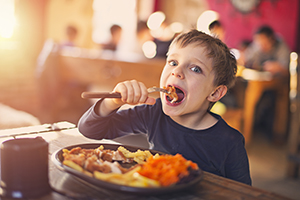
Full disclosure: I do not have children—by choice. But this does not preclude me from having a strong opinion about how we feed our kids.
Check out any popular restaurant menu—especially chain restaurants where families often gather—and you’ll see the following options on the children’s menu: Chicken tenders, hot dogs, mac ‘n cheese. A glut of mostly fried foods and lots of starchy refined carbohydrates. These items are ubiquitous among other favorites like a mini hamburger, tater tots or a spaghetti dish with sauces resembling ketchup. Just try to avoid gluten and dairy on these menus!
It’s no secret that children are heavily influenced by what their parents eat, and this creates teachable moments every day at the family table. It’s an opportunity to model healthy eating behavior, which is critical—especially in a child’s formative years.
We know that children usually don’t do as you say, they do as you do. They’re not going to eat their vegetables unless you do—consistently. Every day. I’ll never forget a rotation at a day-care center during my dietetic internship, where a child was offered a lunch which included a salad and retorted, “My mommy doesn’t eat that!” and refused to eat it. The impact of learned eating behavior from that parent was clearly evident.
So unless you’re eating the broccoli that you insist they eat, they’re not going to. Moreover, it can take as many as 17 exposures—and maybe more—to said broccoli (or any other new food) at the dinner table before your child will agree to even try it, according to the research. I think a good strategy is to only have healthy offerings available at home. For example, snacks of raw veggies with a dip like hummus or guacamole, fresh fruit in season and nuts (if not allergic). This can translate to kids seeking similar food items when eating out.
And please, if your child is overweight, DO NOT make comments about his/her weight or tease them in any way. Doing so plants the seeds of an eating disorder which can become full blown by the time they reach adolescence. The scientific literature shows that weight teasing is linked to unhealthy weight control behaviors and binge eating.
In fact, the American Academy of Pediatrics reports a link between weight control efforts and disordered eating in teens. Therefore, they recommend focusing on teens’ healthy eating rather than weight to improve unhealthy eating behaviors.
Your children’s eating habits are shaped by yours—you are their social reference. Modeling healthy eating behaviorevery day will have profound benefits throughout their lives.
To your children’s health!
As you may know, I’ve been doing a weekly “Q&A with Leyla” podcast feature with Dr. Hoffman. Now you can get my perspective and expertise every Friday on my own episode of the Intelligent Medicine Podcast. If you missed last week’s, you can listen here. To be sure you don’t miss out on any of my important insights and information, subscribe today!