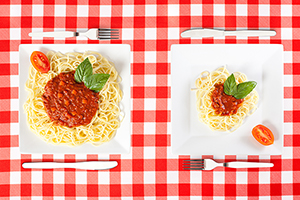
Portion size, that is. Did you know a New York bagel was about the size of a hockey puck back in the 1970s? Today, it’s equivalent to four or five slices of bread. And if you hollow out the middle, about three slices of bread. Not much better, right?
And whatever happened to the 6-ounce cup of brown coffee—the standard for a hot beverage serving? Now, your “grande frappa-mocha-whappa” (your designer beverage choice) is equivalent to an ice cream sundae. Since when did a plain ol’ cup of joe become a full on dessert, besides tripling in size?
That large “tub” of popcorn at the movies? Do you realize it’s about the size of the wastepaper basket commonly used in your bathroom or office?
The interesting thing is the scientific literature reveals that most often, we will accept the amount of food or beverage served as the ‘right’ amount – the amount we’re supposed to get. And more often than not, we will finish it! This is the work of Brian Wansink, Ph.D., Professor of Marketing and Nutritional Science at Cornell University. He has proven this via his original research, “Why We Eat More Than We Think” (from his book, Mindless Eating).
Dr.Wansink has shown that the size of our plates can determine how hungry we feel, and this may explain why we overeat in restaurants. Why restaurants? Look at the size of the plate (or platter!) they serve your entrée on and then compare that to the size of your standard dinner plate at home. In fact, plates from the 1950s were a couple of inches smaller in diameter than today’s dinnerware (9-10 inches vs. 11-12 inches). Dr. Wansink explains that the size of the plate (or popcorn bucket) “can provide subtle but powerful suggestions about how much one should eat.”
We’re operating on a conscious or unconscious belief that the amount of food we’re served is the correct amount to consume—thereby determining how hungry we feel.
Compared to the French, Americans stop eating “when the plate is empty or when the television show they’re watching is over.” The French stop eating when they’re no longer hungry. The difference? The French pay attention to internal satiety cues.
The next time you’re in a restaurant or movie theatre, take a hard look at the portions you’re getting, and compare them to the amounts you would actually serve yourself at home. If you popped that popcorn yourself, how much would you actually eat? This exercise alone can change your perception of hunger.
So you see, when it comes to eating, bigger is definitely not better.
To your health!
Leyla Muedin, MS, RD, CDN