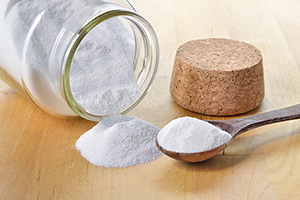
Q: Is there any benefit to raising urine pH by taking a teaspoon of sodium bicarbonate each day?
A: The answer is no. This is not the best way to add alkalinity. Taking bicarbonate daily will lower stomach acid which is essential for healthy digestion. The sodium in it can cause fluid retention. Plus, long-term use of bicarbonates may cause leaching of important minerals like calcium, magnesium, zinc and copper.
You may have heard that eating more “alkalizing” foods is desirable versus acid-forming foods for optimal health. That eating more vegetables and fruit which are alkaline-promoting, and eating less acidic foods, is the way to go for a healthy body and good bone health. Hence the recommendation by proponents of bicarbonates as a supplement to increase alkalinity.
Fortunately, Nature has taken care of this for us. In our ancestral diet, there was a balance of acid-forming and alkalinizing foods. The animals our hunter-gatherer ancestors killed and ate, and the leaves, vegetables and roots they gathered fell into either category of acid-forming or alkalinizing foods. Animal proteins being acidic, and produce, seeds, and most nuts being alkalinizing.
The natural fats inherent in our food for the most part are neutral, neither acidifying nor alkalinizing.
In our modern diet, which began with the dawn of agriculture, we have two additional food groups: grains and dairy. Both of these food groups are mostly acid-forming (with the exception of yogurt and whey). Most beans and legumes are also acid-promoting.
So how important is all this? Read on.
PH is a measure of acid and alkaline in the body on a scale of zero to 14. The lower the pH, the greater the acidity; the higher the pH, the greater the alkalinity. The acidic or alkaline nature of the foods we eat has little influence on our serum pH. We are happily balanced at a healthy 7.4 pH which is slightly alkaline. Our metabolisms function elegantly to maintain this blood level pH, or we would not exist. Indeed, a small shift in either direction would have dire consequences. Secretion of an acid or alkaline urine by the kidneys is the mechanism that helps the body to maintain a constant pH.
On the other hand, urine pH is affected by diet, diseases and certain medications. The range for urine pH is generally between 4.5 and 8.0. Urine that is at the extreme high or low end of pH is a risk factor for kidney stones. As you can see, a mid-range pH is desirable.
Keep in mind that urine pH levels are an imprecise indicator of the overall pH of the body, so don’t bother with urine pH strips. Yes—those strips will show a more alkaline urine after you have a green drink or smoothie for breakfast but several hours later, the body will return to homeostasis.
To your health!
Leyla Muedin, MS, RD, CDN