These days, one of the most popular themes in nutrition is methylation. It’s a complex subject, but suffice it to say, it’s one of the best examples of how using supplements can enhance health. Supporting methylation is also about personalized nutrition—using genetics to inform our choices about which nutrients are best for us. Here’s a great review of the subject by our friends at Protocol for Life Balance. . .
—Dr. Ronald Hoffman
This article contains content from one of our trusted sponsors.
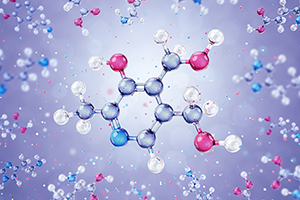
Methylation is a biochemical process occurring in all cells of the body. It refers to the addition of a methyl group (a small molecule made of one atom of carbon and three atoms of hydrogen) to an organic compound (protein, DNA, hormones, vitamins, neurotransmitters…). Methylation enzymes serve to attach a methyl compound to its substrate. The process of methylation aids in the activation of certain vitamins, energy production, detoxification pathways, and more.
It is impossible to detail each methylation pathway that occurs in the body in one article; therefore, a few important ones are described herein.
DNA methylation is an important part of the maintenance of normal DNA structure. As we age, a gradual DNA hypomethylation occurs at the genome-wide level. This phenomenon leads to genome instability, or modifications in the expression of certain genes (also known as epigenetic changes). Anomalies in cell division may be triggered, resulting in the formation of “rogue” cells, or cells not performing the functions they were genetically programmed to do.1
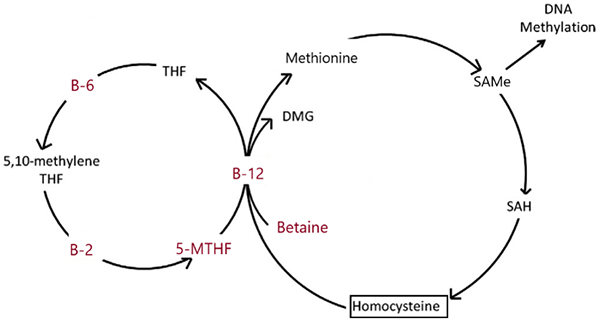
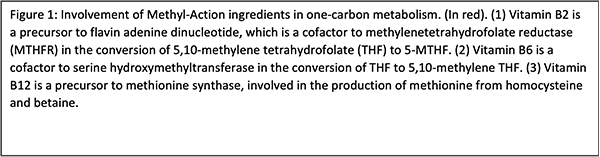
The one-carbon metabolism pathway is a biological cycle that occurs within cells and is necessary for proper DNA methylation as well as for recycling homocysteine, a compound known to be linked to cardiovascular risk.1 To function properly, this cycle needs dietary sources of vitamins B12, B6, B2, folate, betaine, choline, and methionine.(Figure 1) Insufficient intake of these nutrients may result in a dysregulated one-carbon metabolism pathway, which may result in decreased S-adenosyl methionine (SAMe) production and DNA methylation and increased homocysteine levels.1
Furthermore, the enzyme methylenetetrahydrofolate reductase (MTHFR) is a pivotal enzyme that catalyzes the conversion of inactive folate to 5-methyltetrahydrofolate (5-MTHF), the main form of active folate necessary for the proper functioning of the one-carbon metabolism pathway. Some individuals are born with genetic mutations of this enzyme and cannot efficiently activate folate. This can contribute to various health conditions such as male infertility, pregnancy loss, neural tube defects, and cardiovascular, autoimmune, and neurodegenerative disorders.2 Up to 40% of Caucasian and Hispanic Americans carry an anomaly of the MTHFR gene.3
B-vitamins have other functions outside of the one-carbon metabolism pathway. They are required as co‐enzymes for numerous biochemical reactions that are essential to cellular function and energy production, notably at the mitochondrial level.* Some of the systems in which B vitamins function can be summarized as follows: riboflavin is important for cellular respiratory chain, energy metabolism, metabolism of neurotransmitters; vitamins B6 and B12 are involved in cellular energy production, glutathione and nucleotides biosynthesis; and folate is essential for the biosynthesis of nucleotides and S‐adenosylmethionine (SAMe).* While it is not a B-vitamin, betaine is an essential component of the one-carbon metabolism pathway.* As a methyl group donor, it helps recycle homocysteine and support healthy liver function.* It also helps to maintain intercellular osmolarity and protects proteins from denaturation.*
Dietary supplements containing the micronutrients involved in the one-carbon metabolism pathway will help support healthy methylation, resulting in the production of SAMe for healthy DNA methylation and the proper recycling of homocysteine.* Furthermore, for individuals with MTHFR gene mutations who have difficulties activating folic acid into 5-methyltetrahydrofolate, supplementing the diet directly with 5-MTHF will result in an optimized one-carbon metabolism cycle.*
Protocol For Life Balance® is a brand of affordable high-quality dietary supplements offering supplements that support healthy methylation.* Notably, Methyl-Action, which combines high potencies of vitamins B2, B6, B12 in their active forms with proprietary Quatrefolic®, a unique glucosamine salt of (6S)-MTHF, the active form of folate. This product also includes 1,000 mg betaine (trimethylglycine) per two capsule servings to further support the methylation process.* Other products from Protocol For Life Balance® that support healthy methylation and could be taken in combination with Methyl-Action are SAMe 200 mg and 400mg.*Ɨ When selecting a supplement to support healthy methylation, it is also recommended that it be done in conjunction with a healthcare professional who can test for homocysteine levels and for the presence of a MTHFR mutation and create a customized support program.*
* These statements have not been evaluated by the Food and Drug Administration. These products are not intended to diagnose, treat, cure, or prevent any disease.
Ɨ For a complete list of Protocol For Life Balance® products containing the three products described in this article, please visit website protocolforlife.com
References:
- Anderson OS, Sant KE, Dolinoy DC. The Journal of nutritional biochemistry. 2012.
- Coppedè F, Denaro M, Tannorella P, Migliore L. Mutation Research/Fundamental and Molecular Mechanisms of Mutagenesis. 2016;787:1-6.
- Moll S, Varga EA. Circulation. 2015;132(1):e6-e9.