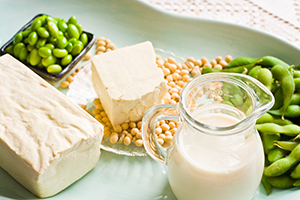
Q: I read various health newsletters, books, and websites on nutritional advice, and I’d like your opinion on something I recently came across. It was one of those click-bait videos whose tagline was: “Which health food you should be avoiding?” It turns out it’s soy!
I’ve been a big fan of tofu in my stir-fry, and sometimes I use organic soy milk. Please give me the lowdown on soy—should it be eliminated as this doctor thinks (Dr. Steven Gundry)?
A: There is still much controversy about soy. Whether it is a healthy food or not depends on whom you ask.
Paleo and low carb aficionados, like the doctor you mention, avoid most if not all legumes, including soy. Soy is also a goitrogen that inhibits the uptake of iodine by the thyroid necessary for production of thyroid hormones. For this reason, I recommend those individuals with diagnosed hypothyroidism eliminate soy from their diets. However, fermented soy foods such as tempeh and miso are far less goitrogenic and are well tolerated by many. Use tempeh in your stir-fry instead.
Another problem with soy is that most of the crop in the US is genetically modified (GMO). Unfortunately, this confers a higher tolerance to herbicides so farmers can just amp up their spraying of crops which increases our toxic burden when we eat soy and soy-containing foods. Moreover, soy is listed as one of the top eight food allergens along with peanuts, tree nuts, milk, wheat, eggs, fish and shellfish.
Another concern is the phytoestrogens inherent in soybeans. In my practice, I’ve heard first-hand accounts from my female clients going through menopause proudly claiming they have alleviated their hot flashes with a daily glass of soy milk—eliminating the need for hormone replacement therapy (HRT). Wow! That must be some pretty powerful stuff. Dare we call it unregulated HRT? Hmmm…food for thought.
Regarding breast cancer, there are two schools of thought. Proponents of soy intake assert that the weaker phytoestrogens it contains are taken up by estrogen receptors in the body, thereby displacing stronger endogenous estrogens—helpful for those with estrogen receptor-positive breast cancers. Dissenters, however, claim those phytoestrogens increase the total burden of estrogen in the body, spurring cancer growth in susceptible individuals.
Finally, the phytoestrogens in soy may quash testosterone levels in men. This may be desirable in the setting of prostate cancer where lowering testosterone may be of benefit, but not great for bolstering fertility in young men.
To your health!
As you may know, I’ve been doing a weekly “Q&A with Leyla” podcast feature with Dr. Hoffman. Now you can get my perspective and expertise every Friday on my own episode of the Intelligent Medicine Podcast. If you missed last week’s, you can listen here. To be sure you don’t miss out on any of my important insights and information, subscribe today!