Over the last couple of weeks, I had the opportunity to tour New Zealand on a combined biking/hiking adventure with Vermont Bike Travel. I was joined by an old grammar school, junior and senior high school friend of mine, also an avid biker. It was fun to bridge the chasm of decades of our separate life paths.
The tour started in the capital, Auckland, where I visited one of our sponsors, Calocurb, which is based there. I toured a New Zealand government research facility with Sarah Kennedy, Calocurb’s founder, and Dr. Ed Walker, their lead researcher. I was impressed with the rigor of the science underlying this natural New Zealand hops-derived GLP-1 activator that supports satiety. You’ll be hearing more about their latest study that validates the claim that Calocurb can yield tangible weight loss results on future episodes of the Intelligent Medicine podcast.

A bicycle tour across the South Island
We met with our tour leaders and fellow adventurers after a short flight to the South Island, best-known to U.S. audiences as the land of Hobbits and the spectacular setting of Peter Jackson’s Lord of the Rings films. Its rugged scenery and other-worldly rain forests, mountains, meadows, rocky shorelines, lakes, and glaciers certainly met our expectations.
As an island geographically isolated from continental land masses, New Zealand boasts unique trees, plants, and weird animals—like the extinct giant moa, kiwis, parrots, lizards, seals, and dwarf penguins and dolphins—found nowhere else. New Zealanders are very eco-conscious, since tourism is their 2nd major industry (export of natural beef, lamb, venison, and dairy products ranks number one). Early settlers introduced invasive species that out-competed indigenous flora and fauna, and conservation initiatives are underway to eradicate the interlopers and revive endangered species.
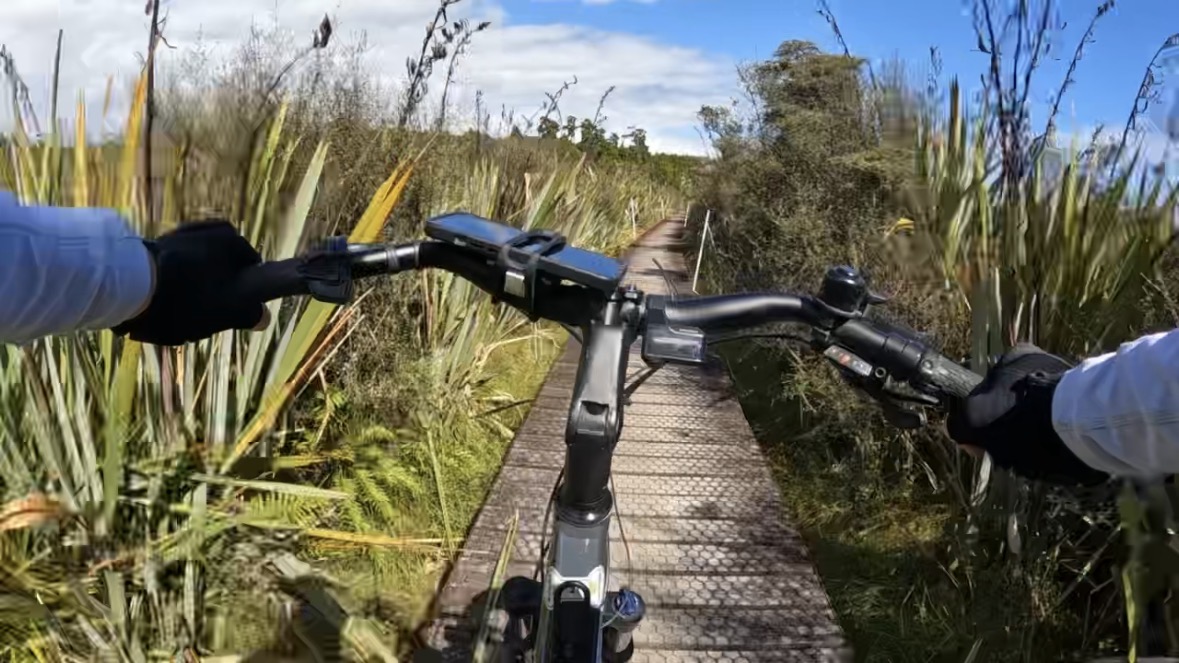
I’m an avid bicyclist, but most of my experience is on paved roads riding an aero bike with narrow tires. This trip took us on narrow gravel and dirt paths through luxuriant canopied forests, with hair-pin turns and steep ascents and descents. To negotiate the terrain, my travel buddy and I opted for e-bikes with wide, grippy tires, as did all but one of our riders.
Unfamiliar with off-road cycling, I found it just challenging enough to make it exciting, but not so grueling as to make it an ordeal. At first, I found the heavy e-bike balky, but soon grew accustomed to it and used the lowest setting of power-assist to get me up steep inclines. If ever I grow too feeble to ride my usual routes with a traditional bike, it’s reassuring that the e-bike option looms.
A special group of riders
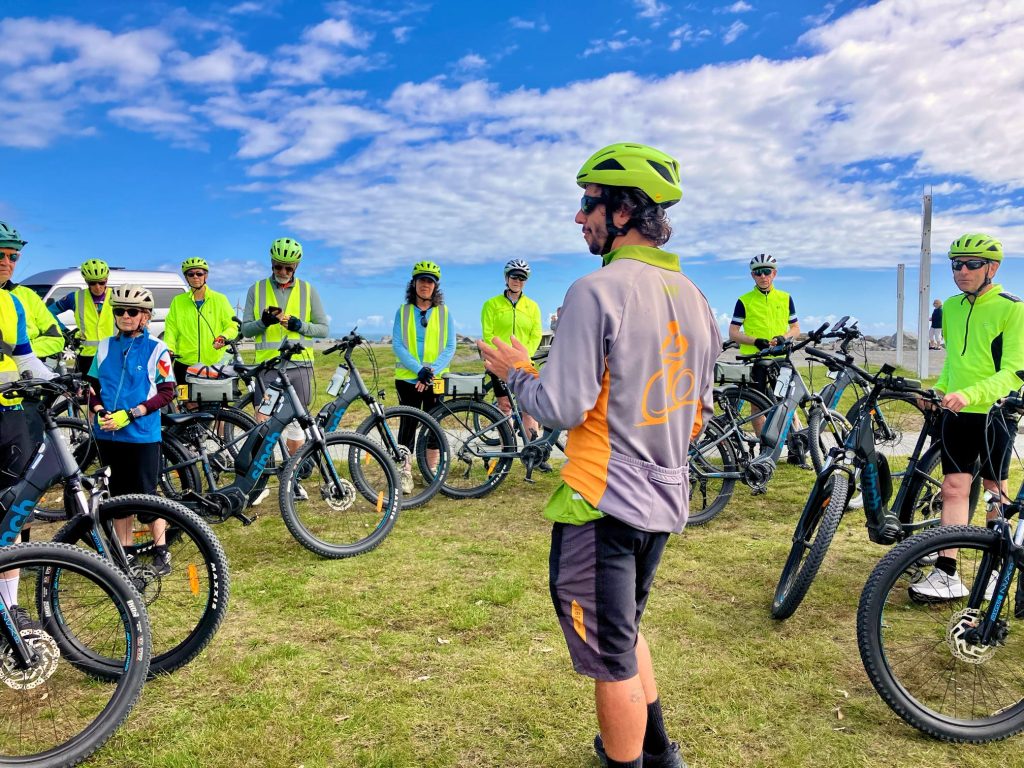
A word about our group. The vast majority were in their 60s to early 70s like me and my friend. I was super-impressed by their intrepidness and conditioning—most were inveterate cyclists. It takes physical stamina and mental alertness to avoid crashing out on narrow trails, and we covered fair distances.
Muscle strength, balance, sound joints, cardiovascular fitness, and even vision play crucial roles in cycling; all can be compromised by aging.
Most people over 60 are plagued with ailments or too debilitated to contemplate such a journey. Plus, cognitive limitations make it too daunting to navigate unfamiliar bike routes and attend to all the logistics of travel and preparation with packing and repacking for early morning bus trips from our accommodations to our next destinations to begin each day’s ride or hike or kayak. These were not individuals content to just board a cruise ship to gorge on delicacies and hit the bar for a cushy getaway.
They were self-selected not just on the basis of fitness, but also, as retired or semi-retired individuals with grown-up kids, with requisite time and income after successful careers to afford a bucket-list two-week sojourn. I was proud to be able to keep up with this cohort of healthy seniors.
Not that there weren’t some physical challenges to overcome. I came to learn that some of my fellow adventurers had joint replacements to hips or knees; one, after suffering a devastating bike crash, made a comeback after traumatic brain injury; others had survived serious brushes with cancer; one had insulin-dependent diabetes; another a previous heart attack, which didn’t prevent him from tackling a long steep uphill—with the eco-boost turned off!
Additionally, one of our tour leaders recounted a hairy incident where a guest, on blood thinners, bled profusely after what would ordinarily have been a minor scrape. There were even past mishaps—fortunately not on our tour—where guests rode off narrow foot paths into surrounding marshes or into steep ravines.
New Zealand is home to the Māori
No visit to New Zealand would be complete without exploration of indigenous Māori culture. The colonization of New Zealand by whites in the 19th Century parallels the subjugation of Native American tribes in the U.S. But Māori culture persists. You see it in rugby competitions where the Blacks—New Zealand’s foremost team—perform a traditional fierce Haka before their matches. You see it in the signage which is English and Māori. You see it in the place names. And you see it in the people, many of whom proudly sport elaborate traditional Māori tattoos—some covering their faces. 4% of the people converse in their native Māori, and it’s offered as an option in public schools.
(As I write this in the Auckland airport, two traditionally-dressed women near me are conversing in Māori language.)
Faithful reenactments of ceremonial rituals and dances keep the Māori traditions alive—we saw some fascinating demonstrations. And they’re not presented as tacky spectacles for tourists, but rather, as deeply spiritual representations of traditional Polynesian culture.

The toll of Western lifestyle
But just as in the States, the indigenous population suffers depredations. As with today’s Native Americans, you can see the devastating effects of Western diet and lifestyle on the populace. Faced with a layover due to a missed plane connection, I wandered into an all-you-can-eat establishment and found myself the only white person among traditionally-dressed Māori. The hostess explained that it was a wedding reception, but I was free to pay for a meal. As I sat discretely in a corner, I couldn’t help noticing the prevalence of obesity. And no wonder—the offerings were heavily slanted toward starchy and sugary treats, along with fried fish, chicken nuggets, sausages, and fatty cuts of pork and lamb in heavy sauces.
A book I read about New Zealand reported that in the mid-twentieth century, it was the rare Māori who had their own teeth after the age of 30. Diabetes and alcoholism are rampant, and the average life expectancy of indigenous people is far below that of their non-Māori counterparts.
It seems that, after centuries of a rigorous subsistence lifestyle with a traditional diet consisting mostly of fresh fish, shellfish and eels, along with tubers and berries, the Māori population—like Native Americans—acquired “thrifty genes” that made them especially susceptible when processed foods were introduced.
On the plus side, I saw nobody smoking, with only the occasional vaper. The scent of pot, which pervades New York City sidewalks where I live, is absent. Marijuana remains illegal in New Zealand for recreational use, with penalties including fines or imprisonment for possession, cultivation, or supply. There’s a pathway for medical marijuana, but it’s carefully regulated.
Is there a doctor on board?
On the flight to New Zealand—which took 18 hours nonstop from JFK—I sat next to a garrulous Australian and shared that I was a physician. I was joking with him that, with over 200 passengers on board, it’d probably be my bad luck to be called for a medical emergency, as has happened numerous times on my flights and even cruises. Not a half hour after I said that, as I settled in for a nap, a commotion started around the aisle seat directly across from me!
I leaned over and identified myself as a doctor. A young man had fainted in his seat. He quickly regained consciousness. I asked his wife if this had happened before? Never. Was he on any meds? No. Any underlying conditions? No. His pulse was regular, although a little thready. He responded to my questions appropriately and said he was feeling better. No chest pain, no trouble breathing. I tested his limb strength and asked him to smile and move his eyes to see if he had signs of a stroke. All normal.
The flight attendant brought some orange juice, and placed an oxygen mask on the passenger, which I said was unnecessary. I concluded he had a vasovagal syncopal episode, prompted by stress and/or low blood sugar. I kept checking in on him during the flight, but he was ok. The drama was over.
All in all, a fascinating and informative adventure! Glad to be back to continue delivering the fresh Intelligent Medicine content you enjoy.
And so, the traditional Māori salutation Kia ora!
For photos and videos of my trip, visit my Facebook page.