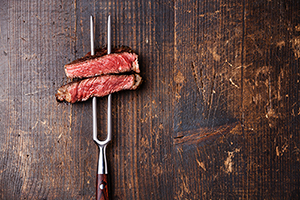
“I’m trying to cut down on red meat.” It’s a familiar trope when I take a dietary history from new patients. People are feeling guilty these days about consuming beef, veal, lamb, and pork products. They’re taught that meat consumption is unhealthy. And lately, they’re being persuaded that it’s unvirtuous from a societal standpoint.
Let’s take a critical look at some of the most familiar lines of attack against red meat.
Environmental concerns: Meat consumption is said to be linked to the emerging threat of climate change. It’s resource-intensive, and methane from livestock is said to be contributing to global warming. Plus, factory farms are polluting and the global demand for meat is in part responsible for destruction of the Amazon rain forest, which is being clear-cut for pastures and forage land.
There are those who push back on this narrative. They claim that meat production can be made sustainable. After all, the vast grasslands of the American prairies were once a thriving, renewable ecosystem that supported herds of millions of bison that fed Native Americans for millennia.
The defenders of meat point out that agricultural crops also require enormous amounts of water and fertilizer; Carbon-based fuels are needed to harvest fruits, vegetables, legumes and grains and transport them fresh to distant markets. Plus, meat is a “perfect food” that humans have sought since the dawn of human evolution to supply concentrated, high biological value protein and calories; vegetarian substitutes like the “Impossible Burger” are highly-processed and artificial.
Animal cruelty: This is a moral argument that can’t be contravened merely with well-meaning measures to mitigate animal suffering; there’s no way around it: animals need to be slaughtered—“humanely” or otherwise—if humans are to subsist on animal protein. New technologies to bio-engineer cell cultures grown in chemical media may eventually solve the moral dilemma—but will “test-tube meat” be healthy and environmentally sound?
Epidemiological studies: Studies keep coming out that suggest that meat eaters are less healthy than those on plant-based diets. Those who forego red meat are said to have less cancer and heart disease, and are leaner and more fit. But few studies or meta-analyses control for the fact that people who avoid red meat may be better-educated, more affluent, exercise more, or avoid junk food—meat avoidance may be a marker for conscientiousness in other walks of life that impact health outcomes.
Very few studies attain a level of precision that allows them to discern whether judicious consumption of unprocessed meat—not cold cuts, hot dogs or fried pork rinds—can be prudently incorporated in a diet rich in fresh fruits vegetables and spices by individuals who exercise, drink responsibly, and don’t smoke.
Red meats are a source of saturated fats: More studies are vindicating saturated fat in the causation of major diseases—including heart disease. Also, the type of saturated fat may be consequential to their effects—is it lauric, stearic, or palmitic? More nutrition experts are acknowledging that the impact of saturated fats is modified by the context in which they’re delivered.
It’s also suspected that vulnerability to the adverse effects of saturated fats is genetically-determined via the STAT gene. Some have it, some don’t.
Red meat, while high in stearic and palmitic acid, also delivers generous amounts of oleic acid and polyunsaturated fatty acids. Grass-fed meat has more desirable Omega 3 and less pro-inflammatory Omega 6 than conventional grain-fed varieties.
It could be argued that the satiety delivered by the ample protein and fat in meat displaces the consumption of sugars and starches which are the real drivers of insulin resistance—the more well-substantiated cause of our modern epidemics of diabesity and heart disease.
Red meats are laden with cholesterol: The dietary cholesterol hypothesis is fast-becoming the shibboleth it was always destined to be. The liver manufactures around 90% of our LDL and HDL. The foods you eat add little. Even the retro American Heart Association is recanting its long-standing stigmatization of dietary cholesterol.
“Acidifying”: Another knock against meat is that it tips acid-base balance toward a harmful acidified state. But research suggests acid load results more from modern over-consumption of cola beverages, sugar and refined carbohydrates, and phosphorous additives in processed foods. And studies of modern hunter-gatherers who include ample meat in their diets reveal their net acid loads to be favorable, probably due to the compensatory effects of eating lots of fruits and vegetables and avoiding processed junk.
As you can see, most of the arguments against red meat consumption have at least some degree of doubt to them. So if you were planning on cooking up some steaks this Labor Day weekend, you may be able to do so with a little less guilt (although you should make sure you’re choosing grass-fed and finished beef!).
Join me again next week, where I’ll be putting six more arguments against red meat consumption to the test!