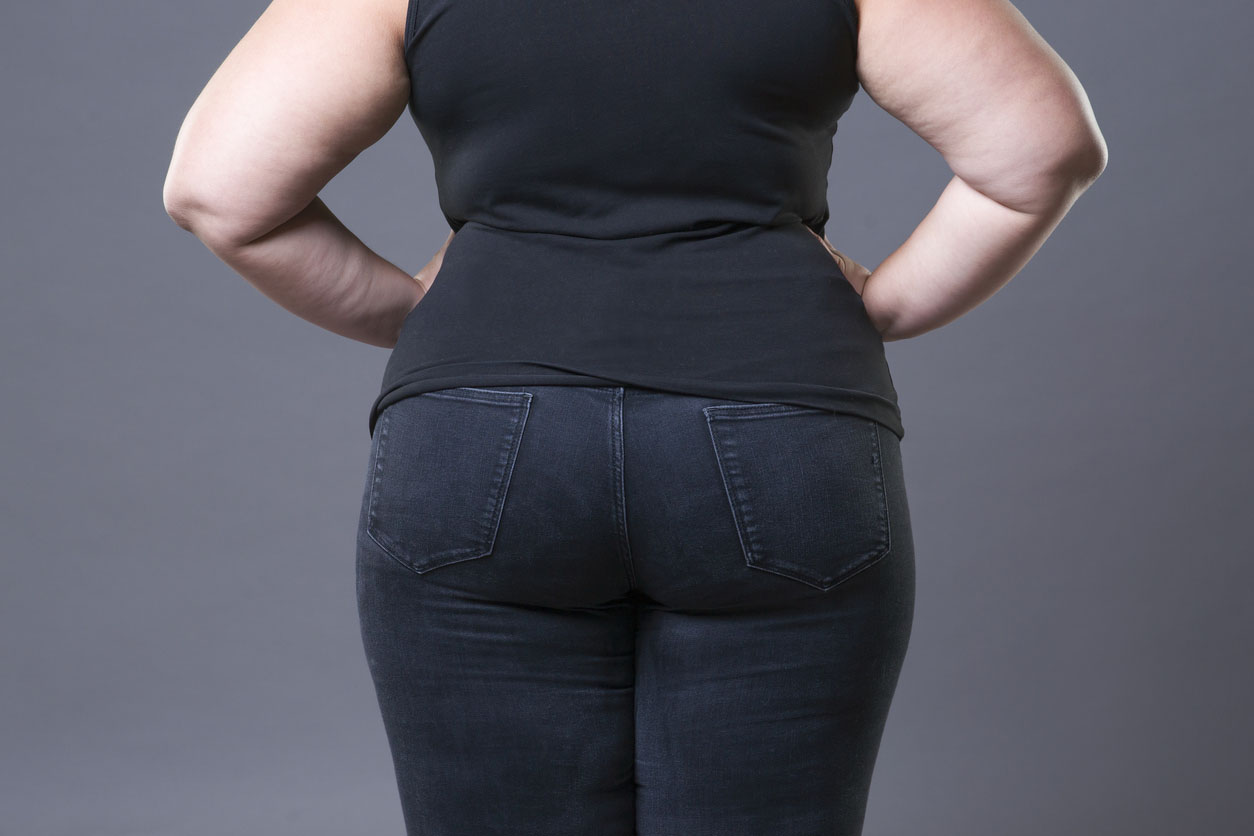
Researchers have discovered that the size and shape of your derrière can reveal important insights about your disease risk.
Pop music fans will undoubtedly recall Meghan Trainor’s 2014 hit song “It’s All About That Bass”. It’s a play on words, with a strong musical bass line, but also conveys a message about self-acceptance and body-positivity to her female fans with body shapes outside what society lauds as ideal:
Because you know I’m all about that bass, ‘bout that bass, no treble
“All About That Bass”
Yeah, it’s pretty clear, I ain’t no size two
But I can shake it, shake it like I’m supposed to do
‘Cause I got that boom, boom that all the boys chase
And all the right junk in all the right places
If you got beauty, beauty (ah), just raise ‘em up
‘Cause every inch of you is perfect, from the bottom to the top
Yeah, my mama, she told me, ‘Don’t worry about your size’
And, no, I won’t be no stick-figure silicone Barbie doll.
© 2014, Meghan Trainor, Kevin Kadish
That’s because Trainor was contoured more like a cello than an hourglass—ample on the bottom, tapered at the waist, but less well-endowed up top.
For a while, perhaps inspired by celebrities like Jennifer Lopez and Kim Kardashian, there was a big booty aesthetic that prompted women to undergo often dangerous rear-end body work. The BBL (Brazilian Butt Lift), entailing fat extraction from the belly via liposuction followed by reinjection into the buttocks, is considered among the riskiest of cosmetic interventions. Not to mention illicit practitioners who offer back-alley shots of industrial silicone that can turn lumpy, painful and infected.
Now, scientists tell us, your glute shape can be a predictor of diabetes risk:
“Researchers in the UK used three-dimensional MRI to study how age-related changes in the shape of a person’s gluteus maximus (GM) muscle were associated with an increase in T2D risk over time . . .”
They reviewed the scans of 61,290 individuals to see if the size, shape, and composition of their gluteus muscles were related to health outcomes.
There are actually three gluteus muscles that give volume and contour to our rear ends: gluteus maximus, medius, and minimus. The gluteus maximus is considered the largest, heaviest and most powerful muscle in the body. It is responsible for keeping us upright and for stabilizing the hip.
“Dead butt syndrome”
Because we spend a lot of our time sitting, our glutes tend to atrophy, leading to back, hip and even knee instability problems. Weak glutes can be the bane of runners and cyclists. Loss of muscle-memory leads to deactivation of neural pathways to the glutes, sometimes referred to as “dead butt syndrome” a.k.a. “gluteal amnesia”. According to Men’s Health:
“The phenomenon happens when the gluteus medius, one of the three major gluteus muscles, isn’t engaged and worked regularly. Without that attention, our biggest butt muscle group stops functioning the way it’s supposed to in order to help us move efficiently.”
It’s not just that the muscle is atrophied, it’s also that the nerve connections between the brain and posterior chain have been enfeebled, making it hard to get the glutes to “fire”.
Male vs. female butts
After reviewing thousands of MRIs, the researchers found something counter-intuitive: There were major sex differences in how glute size impacted diabetes risk.
Large derrières in women were associated with type 2 diabetes incidence, whereas in men flat bottoms predicted risk.
“We were surprised, not just by the scale of the differences, but by how sharply the muscle shape patterns linked to type 2 diabetes diverged between men and women,” Louise Thomas, PhD, professor of metabolic imaging at the University of Westminster, London, England, told Medscape Medical News. “Men showed clear regions of localized thinning consistent with muscle atrophy, whereas women showed outward bulging that likely reflects increased fat deposition,” she explained.
Many of us would easily recognize the stereotype of the unhealthy middle-aged male: Cigarette dangling from his lips, a six-pack in hand, big belly overhanging his waistline, but with pants sliding down over a concave butt.
By contrast, women are endowed with estrogen, which routes surplus calories to subcutaneous fat depots in the tummy and breasts, but especially in the buttocks. Could it be that ample female posteriors confer an evolutionary advantage, signaling enhanced fertility potential to prospective mates?
Turns out it’s not just size, but also the composition, of glute muscles that determines risk of diabetes.
Muscle as an endocrine organ
As muscle ages and becomes more metabolically unhealthy, it becomes marbled with fat. This undermines the role of muscle as a glycogen depot, but also as a source of signaling molecules called myokines, which help with blood sugar regulation. Myokines, in addition to tamping down inflammation and supporting brain function, are now known to boost metabolism and enhance insulin sensitivity.
Hence, diminished quantity as well as quality of muscle undermines glucose control, and hastens chronic diseases. Which is why building muscle is not merely a matter of aesthetics.
Indeed, shrunken glutes were found to be strongly correlated with grip strength, a reliable proxy for overall muscle health, and a key predictor of frailty. According to study coauthor Marjola Thanaj, Ph.D., a senior research fellow at the University of Westminster’s Research Centre for Optimal Health:
“People with higher fitness, as measured by vigorous physical activity and hand grip strength, had a greater gluteus maximus shape, while aging, frailty and long sitting times were linked to muscle thinning.”
The authors suggest that, instead of using crude measures like BMI and body fat percentage, radiographic interpretation of gluteus muscle morphology could help refine predictive models of diabetes risk. It’s the new science of “metabolic imaging”.
Not all is lost—there’s a comeback trail. You can strengthen your neglected glutes by doing resistance exercises with weights, bands, or kettle bells. Dead lifts, barbell hip thrusts, squats, lunges, kick backs, bridges, and stair steppers especially target the glutes. Don’t forget to consume adequate protein and consider creatine for a muscle boost.
Lower body exercise, focusing on the glutes, has even been shown to raise levels of anabolic hormones like growth hormone and testosterone, hallmarks of resilience and longevity.
The champion speed skaters in this year’s Winter Olympics have huge—almost comically exaggerated—butts! No wonder—the men routinely squat 400 pounds in preparation for their record-shattering sprints.
Back to Meghan . . .
Notwithstanding “fat acceptance”, Meghan Trainor left her old body in the rear-view mirror. Now 60 pounds lighter, with help from weight loss injections, diet, a personal trainer and a breast lift & augmentation, she’s a perfect figure-8. She told Today:
“No, I don’t look like I did 10 years ago. I’ve been on a journey to be the healthiest, strongest version of myself for my kids and for me. I’ve worked with a dietician, made huge lifestyle changes, started exercising with a trainer, and yes, I used science and support (shoutout to Mounjaro!) to help me after my 2nd pregnancy. And I’m so glad I did because I feel great.“
In a recent performance of her hit song, she’s dropped that line about “I ain’t no size two.”
With probable improvements in her MRI, too.