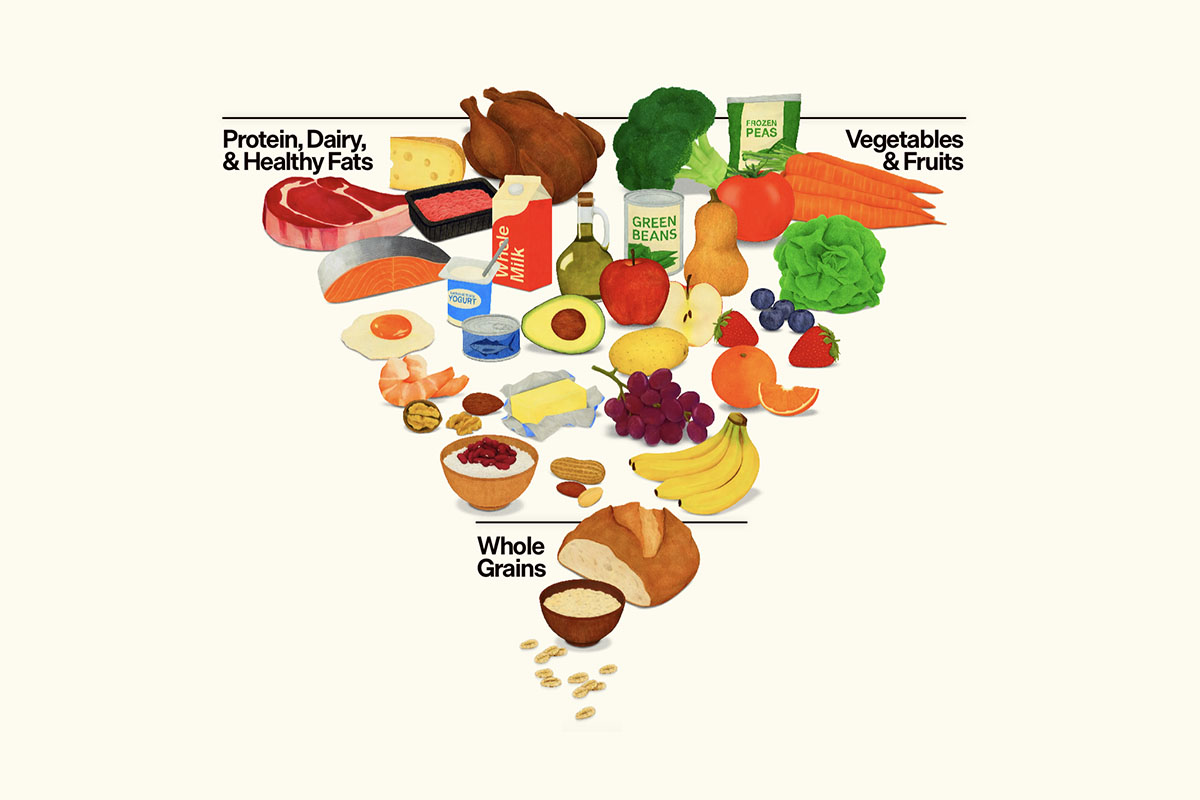
Why so much polarization over the newly-inverted Food Pyramid? What most people can agree upon is that its emphasis on whole, unprocessed food is a step in the right direction. Something on which the previous guidelines committee, mired in “analysis paralysis”, couldn’t even render a verdict.
But the knives are out. Some of the pushback is because flipping the Pyramid seems like trolling the Old Guard who supported a low-fat, “plant-based” paradigm. It feels “Trumpy”, and it emanates from a Republican administration. But since when have our dietary decisions become dictated by our political allegiances? Shouldn’t science prevail?
Perhaps not when it comes to food preferences, long fraught with quasi-religious zealotry!
Where controversy rages is over the roles of the following:
- Saturated Fat
- Protein
- Meat
- Complex Carbohydrates
Let’s break down the arguments . . .
Saturated Fat
True to form, the American Heart Association has a problem with the recommendations:
“. . . we are concerned that recommendations regarding salt seasoning and red meat consumption could inadvertently lead consumers to exceed recommended limits for sodium and saturated fats, which are primary drivers of cardiovascular disease. While the guidelines highlight whole-fat dairy, the Heart Association encourages consumption of low-fat and fat-free dairy products, which can be beneficial to heart health.”
A point of view worth considering, because it’s not “settled science” that saturated fats aren’t the main drivers of cardiovascular disease. On the other hand, hard-core MAHA zealots are mad that the new guidelines “copped out” by urging limitation of saturated fat to 10% of total calories. It’s as if the guidelines authors blinked when it came to opening the flood gates to beef tallow, lard, and full-fat dairy.
The American Society for Nutrition chimed in:
“While the 2025-2030 DGAs maintain the long-standing recommendation that saturated fats be capped at 10% of calories, they also appear to encourage greater consumption of certain foods high in saturated fats such as butter and beef tallow, among others. This mixed messaging may be difficult for consumers to interpret and could inadvertently make it harder for Americans to maintain long-term health.”
The saturated fat foes hew to the belief that LDL particles are like tiny bullets that cumulatively and inevitably embed themselves in artery walls, causing oxidative damage and foam cells; these are the prelude to plaque, obstructed circulation, and attraction of sticky platelets that lead to heart attacks and strokes. According to this formulation, the lower LDL can be maintained over a lifetime, whether via diet or medication, the lower the risk of cardiovascular disease. Period, end of story—it’s said to be as simple as that.
And while dietary cholesterol plays a questionable role in raising serum cholesterol (since the majority of cholesterol is made in the liver), it’s pretty much acknowledged that a high saturated fat diet raises LDL, and replacement of saturated fat with polyunsaturated vegetable fats has been shown to lower LDL.
Part of the problem is that humans used to have an expiration date of 40-50 years, and now we live longer, allowing more time for LDL to do its damage. Hence, it’s claimed, the need to maintain lower levels of LDL to prevent it from doing its cumulative mischief.
But studies show, statistically, people with higher LDLs live longer. Critics argue that sick people—i.e. those with frailty, cancer—don’t make as much LDL, invalidating the association.
But some population-wide studies show that doubling down on the high-fat dairy and meat avoidance recommendations don’t translate to better outcomes.
A recent Swedish study found consumption of full-fat dairy protected against cognitive decline, with cheese and full-fat cream conferring the most reduction. And several studies have now exonerated full-fat dairy as a contributor to cardiovascular disease.
Moreover, a comprehensive review in the Annals of Internal Medicine found no reason to restrict meat consumption on the grounds of cardiovascular prevention.
Besides, LDL is not the sole culprit in heart disease. Numerous other risk factors, equally important, play roles.
My take on saturated fat
The anti-seed oil zealots would have it that refined Omega-6 oils, not saturated fats, are the drivers of our epidemic of chronic disease. Indeed, our intake of these industrially-processed fats has soared, multiples of what our ancestors obtained from eating wild seeds and nuts.
Is the answer to make our French fries with beef tallow, and consume copious amounts of bacon and steak? Some may tolerate high amounts of these foods, but they’re a far cry from what we are evolutionarily-programmed to consume; wild game yields a different fatty acid profile than marbled, corn-fed meat from assembly-line factory farms.
My take is that excess saturated fat, when piled on top of the already highly-caloric, refined carbohydrate-rich diets most Americans are consuming, could be problematic. But meat, poultry, butter, cheese and other saturated fat sources, when consumed in moderation, while adhering to an otherwise low-carb, unprocessed food diet, are unlikely to be a problem for most people.
And just as in the advertising disclaimer, it’s important to remember: “Individual results may vary!” There may be genetic determinants for tolerance of saturated fats: “Jack Spratt could eat no fat, his wife could eat no lean”.
More protein?
A German news outlet, Deutsche Welle, sniffed:
“Studies have shown no additional health benefits from a consistently increased protein intake beyond the currently recommended 0.8 grams per kilogram of body weight.”
But that’s simply not true. The previous recommendations were based on obsolete, decades-old studies that measured nitrogen balance, the bare minimum necessary to prevent breakdown of muscles and organs. Up-to-date science highlights the role dietary protein plays in supporting muscle reserve, especially when teamed with resistance exercise. Using the threshold of 0.8 grams per kilogram per day for a 175 pound man, that translates to a skimpy allotment of just 6 ounces of chicken plus 3 ounces of cheese per day.
It’s reasonable to recommend more protein for active adults, especially for seniors striving to fend off sarcopenia.
Too much meat?
The argument against animal protein is closely linked to concerns over the harms of saturated fat. But is animal protein bad, per se?
It might be argued that modern feedlot meat, and especially processed meat, is hardly Paleo. Its fat composition is different, and it might be laced with growth hormones, antibiotics and herbicide residues, not to mention salt, preservatives, and extenders.
Some studies suggest that heavy meat eaters are less healthy, but results are hopelessly confounded by the fact that many high animal protein consumers also eat an otherwise crappy diet, and engage in less healthy lifestyle behaviors than their more conscientious, plant-based diet consuming peers. When studies are adjusted for these variables, meat often comes out neutral.
One of the values of animal protein consumption is that it delivers ample protein, conferring satiety, helping people avoid craving for poor quality carbohydrates; the latter may be the true drivers of impaired metabolism and obesity.
When challenged with the equivocal data on meat harms, animal protein foes fall back on the argument that it’s better for “planetary health” and “sustainability” to eat plant-based. But that’s another matter entirely; it shouldn’t skew scientific objectivity over what diet is a better fit for optimal human health.
What about those vaunted whole grains?
The previous Dietary Pyramid was built on a base of whole grains—6-11 portions per day! We were urged to eat “Bread, Cereal, Rice & Pasta”, to the detriment of our expanding waistlines. It was a disaster.
All that fiber agrees with some people—others, not so much.
Unscrupulous food manufacturers obligingly exploited the old guidelines by pushing “fat-free” cereals, breads, and cookies laced with a smattering of whole grains to endow them with a health halo.
Undoubtedly, complex carbohydrates can confer benefits, but only when consumed in their natural, minimally-processed form, and by active individuals with unimpaired sugar handling capability. Eaten in moderation, whole grains, legumes and starchy vegetables provide valuable prebiotic fiber and time-release glucose for energy.
But so many Americans these days are overweight and have metabolic syndrome, if not outright type-2 diabetes, which respond best to a low-carb diet. Hence, the new guidelines de-emphasize complex carbs, placing them at the small apex of the flipped Pyramid, prioritizing the aim of addressing America’s current epidemic of diet-driven chronic disease.
Is the “fix” on?
Some ding the new guidelines, accusing members of the guideline committee of being conflicted; they are alleged to have ties to the meat and dairy industries. Even were it so, that’s payback for all those decades that previous guidelines writers were under the sway of the grain and sugar lobbies. Inevitably, there will be winners and losers, and the food industry is already adroitly shifting to “high-protein”, “additive-free”, “keto”, and “minimally-processed” alternatives to recapture our dollars. But the biggest existential threat to their bottom-line: The prospect that ubiquitous use of GLP-1 drugs will reduce overall food consumption by double-digit percentages!