Celebrating 40 years of Intelligent Medicine
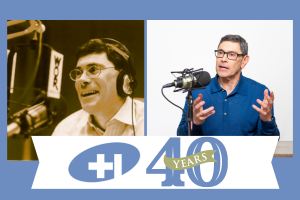
It was 1986. Ronald Reagan was President; The big news story was about an unfolding disaster in a place called Chernobyl; Mike Tyson became heavyweight champion and the New York Mets won the World Series; Madonna had the biggest-selling album—the very same year Lady Gaga was born; the Berlin Wall had yet to fall; a new TV host debuted—Oprah. It was a good year for movies—Top Gun, Aliens, Platoon, and Ferris Bueller’s Day Off were at the Cineplex. Mobile phones were a novelty, costing $3,000 ($8,000 in today’s dollars), and weighing two pounds. Matchmaker.com, the first online dating service, was founded.
That was also the year I began broadcasting—2026 commemorates 40 years of continuous broadcasting of what’s become the longest doctor-hosted health show on radio.
I was a fledgling physician, having completed my residency a few years before, and was practicing integrative medicine out of an Upper West Side brownstone.
One day, I read an obituary noting the untimely death of the MD host of a radio show called In the Doctor’s Office (no, not Carlton Fredericks, who died later in 1987). I got in touch with the sponsors and asked if they were in the market for a replacement.
To my surprise, I was invited to an audition. They hired me! As a prelude to doing live radio, I wrote and voiced “60 Seconds on Nutrition” spots until a radio slot opened up later in the year.
I soon joined the lineup up of WMCA, a legacy 50,000 watt station in New York City, airing every weekend, first for an hour, then for two. Bob Grant, “Mad Dog” Chris Russo, and psychologist Joy Brown were my contemporaries there.
But soon—disaster! The radio station got sold to a Christian broadcast company, and the format changed—I was out.
Luckily, the widow of the late Carlton Fredericks—the revered pioneer of health talk radio—interceded on my behalf to earn me a coveted berth on WOR. With the move came a name change: In the Doctor’s Office became Health Talk.
I started on weekends, and then the station gave me a one-hour afternoon program opposite political firebrand Bob Grant, who was on our talk radio competitor WABC. Talk about counter-programming!
At the time, Dr. Robert Atkins simultaneously hosted a popular evening show on WOR, and as the upstart kid pitted against the veteran broadcaster and best-selling author, we were friendly rivals. When Atkins left the station in the early 2000s, I moved into his nightly spot, while keeping weekends.
Among my most memorable guests over the decades:
Nobel Prize winner Linus Pauling, who extolled the benefits of vitamin C.
Jack LaLanne, who was so energetic in his eighties that I could barely get a word in. “Jack,” I naively asked him, “You must LOVE exercise!” “No!” he snapped. “Do you think I love to get up at 5:00 in the morning and leave my beautiful bride in our warm bed to take a 90-minute swim in icy water while towing a barge with my teeth?? I hate it!! But I love the way it makes me feel afterward!”
Most stressful interview: The Chief Science Officer of Monsanto. This came about in the 90s after I took frequent on-air swipes at the artificial sweetener Nutrasweet. The station manager called me on the carpet and said he’d received complaints from Monsanto corporate. “They demand equal time to rebut you,” he said. “Fine,” I said, “I’ll have their top science guy on air, and he can plead his case.”
So they sent a distinguished senior research scientist and we sparred on air, trading conflicting studies. He was running out the clock, until I decided to take a different tack: “I wonder, professor, do you have any grandchildren?” “Yes,” he said smiling, “They’re eight and ten.” “So would you say Nutrasweet is safe for your grandkids?” “Yes, absolutely,” he replied. “So a glass or two, that would be safe?” “Certainly” he asserted.
“But what would be the upper threshold?” I asked. “Say it would be six or eight glasses a day, every day, day after day, for years. Would that be OK for your little girls?” And that gave him pause. When I put it in personal terms, he was forced to concede sheepishly: “We probably wouldn’t recommend that.” Touché!
Senator Tom Harkin, primary champion behind the creation of the Office of Alternative Medicine (OAM) in 1992, which later became the National Center for Complementary and Alternative Medicine (NCCAM, now NCCIH), shared his vision for mainstreaming natural therapies. He later invited me to Washington to present data about innovative treatments for AIDS to a skeptical young official at the National Institutes of Health—later to gain fame as the Covid Czar—Tony Fauci.
I had the pleasure of hosting the late Suzanne Somers on several occasions. She was a staunch supporter of natural medicine, was well-informed, and a delightful person.
Gary Null, my predecessor on radio and long a broadcasting role model for me, has guested on my show, and I on his.
Dr. Jeffrey Bland, considered the godfather of functional medicine, has long been a presence on Intelligent Medicine, and continues to generously share great updates with Intelligent Medicine listeners.
Celebrity doctors Deepak Chopra, Andrew Weil, and Mehmet Oz also made guest appearances.
Alternative cancer pioneers Dr. Nicholas Gonzalez and Dr. Stanislaus Burzynski, too. I thought the latter was a great “catch” at the time, but my then Program Director at WOR didn’t agree: Within minutes of introducing the heavily-accented Dr. Burzynski I saw the PD wildly gesticulating through the glass window of the control room. “Get that jerk the hell off the air—he sounds like Dr. Mengele!” he shouted into my headphones. In retrospect, perhaps the esteemed doctor was too much of an acquired taste for my AM radio afternoon drive audience.
In those days, every time a new health story broke, I braced myself for a 7:00 AM call from the WOR morning studio to break it down on air for host John Gambling. Before Google was popular, dishing on each new topic cold (“What’s this new Viagra drug?”, “Is it safe to breathe the air around Ground Zero?”) with just a few minutes for show prep presented a real challenge.
For a while, I preceded the late Joan Rivers on air and we had adjoining studios. One day, Joan came over and asked me if I’d like to come on her show. I said “Sure, what’s the topic, Joan?” This was around the time that the Clinton-Monica Lewinsky scandal broke. Joan said: “You’re a nutritionist, right?” “Yes, of course.” “Can you come on and talk about the nutritional value of oral sex?”
“Joan, excuse me, but I’d rather not.” So, I missed my shot at comedy immortality. That was pure Joan, but in person she was lovely and gracious all the same.
But all good things must come to an end—in 2013 WOR came under new management and talent was reshuffled. A mass-exodus of hosts took place, and I landed my current berth on Radio America for a weekend show. But after so many years, I was accustomed to the cadence of weekly plus weekend shows—a total of seven hours of fresh weekly content.
All while holding down a busy medical practice!
Fortuitously, I was able to tap into the advent of a relatively new medium: podcasts. And so it was that, in 2013, I seamlessly embarked on the current hybrid format of Intelligent Medicine (borrowing from the title of one of my books): Weekday podcasts that are comprised of interviews with luminaries in the field of medicine and nutrition, and the popular once-a-week Q&A with Leyla, where I’m joined by my longtime nutritionist colleague Leyla Muedin, along with my traditional weekend call-in radio show, syndicated to more than 130 stations across the U.S.
As a bonus, thanks to AI, we now offer written transcripts of our content via Apple Podcasts!
So deep gratitude to you listeners who have hung with me since the Health Talk days. And welcome to those of you who have only recently discovered Intelligent Medicine. Leveraging our presence on social media, we now have a bigger-than-ever outreach. I promise you a full menu of great health information as we embark on our fifth decade—and hope you’ll join us for the exciting voyage ahead!