America’s love affair with drugs
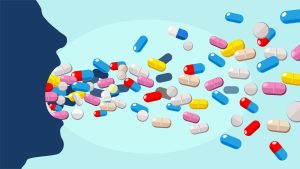
One of the themes of Intelligent Medicine over the decades has been the progressive medicalization of the U.S. From ADHD meds for kids, to antidepressant and anti-anxiety drugs for adults, and all manner of blood pressure, diabetes, and cholesterol prescription options, we embrace chemical fixes.
Not to mention weight-loss drugs, ED meds, painkillers, acid-blockers, bladder nostrums, sleep aids, and powerful “biologicals” for gastrointestinal, dermatological, neurological and respiratory conditions. Lately, the developmental focus has shifted toward “plaque busters” for Alzheimer’s—with hefty price tags, scary side effects, and limited efficacy.
What do these drugs have in common? Unlike antibiotics and cancer treatments, they’re designed for continuous lifetime use, guaranteeing an unlimited bonanza for the pharmaceutical industry.
Chances are you have this . . .
Medical researchers have now concluded that the vast majority of us are sick—it’s just a matter of to what extent. Here’s a headline from the Washington Post:
“90 percent of U.S. adults have this syndrome — but most have never heard of it”
Talk about a clickbait headline!
The malady? CKM, a newly-coined acronym for Cardiovascular-Kidney-Metabolic syndrome, a constellation of aberrations that are said to afflict 90% of adults.
The article quotes Muthiah Vaduganathan, a cardiologist at Brigham and Women’s Hospital who has conducted landmark studies on CKM syndrome and describes it as “a broad disorder that recognizes the overlap between cardiovascular, kidney and metabolic conditions such as diabetes and obesity,”
Features of CKM include high blood pressure, impaired kidney function, elevated blood sugar, cholesterol, and triglycerides, and ultimately heart attacks, strokes and heart failure. All of which have to do with overweight and sedentary habits.
Is this for real, or is it “diagnostic creep”, ensnaring more people in Big Pharma’s grasp?
It’s said that the CKM framework was only formalized in 2023, and physicians were given “guidelines” on how to reverse it.
The guidelines emphasize diet and lifestyle for prevention, but default readily to “fixing” the consequences of CKM with promising new drugs that turbo-charge weight loss, reverse high blood pressure, relieve kidney stress, and lower cholesterol and blood sugar—all of which are encouraged to be leveraged at the earliest possible juncture in the name of “prevention”.
Conveniently offering a sinecure to BigPharma, with an expanded target audience for lifetime adherence.
As the Indie band “Weezer” once put it: “We—are—all—on—drugs, yeah! Never gettin’ enough (never gettin’ enough)!”
Weight loss drugs gaining traction
Weight-loss drugs have achieved massive, record-breaking milestones, with usage among American adults now 11%—up from just 3% in 2024. That’s a four-fold increase in just two years!
Weight-loss and diabetes drugs (GLP-1s) now account for roughly 25% of all pharma forecast sales. The global market for GLP-1 drugs could reach $190 billion by 2035, more than double 2025 levels. For Lilly, maker of Mounjaro and Zepbound, the weight-loss category comprises 56% of their total revenues—and they’ve got a new potential blockbuster triple-action drug, retatrutide, on the launchpad.
Now, with the advent of Medicare coverage for GLP-1 drugs, which will enable enrollees to pay as little as $50 for a month’s supply, expect a dramatic uptick in consumption.
Are we really that depressed?
Approximately 15 to 16.5% of American adults currently take antidepressants, making them one of the most widely prescribed medication classes in the nation. Women are about 2.5 times more likely to be on antidepressants than men.
Lately, questions have arisen over the efficacy and desirability of long-term anti-depressant adherence.
According to Neurosciencenews.com, researchers from the University of Adelaide in Australia reported:
“ . . . there was little robust evidence to suggest that antidepressants prevent relapse beyond 12 months, and the widely cited benefits supporting long-term use may be overstated due to a fundamental flaw in research design.”
The flaw? When people stop anti-depressants, they experience disconcerting withdrawal symptoms—brain fog, bodily sensations, irritability, and yes, depression—that convince doctors and patients that they really need to keep taking antidepressants in perpetuity.
The reality is that when people mature, surmount life circumstances that may have triggered sadness and despondency, or adopt healthy lifestyle habits that depression-proof them, they might not be so reliant on meds after all. But harried mental health professionals are reluctant to undertake the hard work of gradual tapering—they simply take the path of least resistance by renewing prescriptions ad infinitum.
The World Cup of prescription drug use
The United States leads global prescription medication spending, averaging roughly $1,491 per person annually, followed by high-income nations like Germany ($995) and Switzerland ($962). But that doesn’t mean we use more drugs than other advanced countries. We merely pay more for them:
“Americans do not consume significantly more prescription drugs per capita than other developed nations. Instead, the U.S. is an outlier in spending because medication prices are drastically higher. Americans pay anywhere from two to nearly four times more for the exact same drugs.”
Turns out socialized medical systems are more permissive of drug prescribing. The average Canadian adult gets 12 prescriptions per year, against our 10.7. Surveys reveal physicians in France, Germany, and Japan are more likely to prescribe medications to their patients than U.S. doctors. The Guardian reports that “The French retain their fondness for popping pills”:
“French doctors are generous with the tablets, the anecdotes say, with few patients leaving the surgery without a sackful of pills. Some say it’s because the French take their health very seriously, tend to hypochondria, visit the GP at the first twinge.”
Nevertheless, 60% of American adults take at least one prescription medication consistently.
But there’s hope. There’s an emerging trend in academic medicine toward “deprescribing”. A recent op-ed in JAMA called for more studies aimed at rolling back unnecessary drug prescribing:
“Deescalation, discontinuation, and deimplementation trials have emerged in multiple health care contexts in which interventions are suspected of being inappropriately used, applied beyond their evidence base, or continued after they cease to offer meaningful benefit. These studies examine whether and how doing less—such as decreasing medication dosages, discontinuing screening tests, or shortening treatment regimens—can yield superior or at least noninferior outcomes compared with continuing current levels of medical services or products. By evaluating the effects of strategies to scale back existing interventions on health outcomes, adverse events, and/or burdens to patients or society, these trials challenge the traditional assumption that more clinical care is inherently better clinical care.”
We can only hope that this trend continues, invigorated by an expanding awareness of the benefits of diet and lifestyle and natural interventions that we talk about on Intelligent Medicine.